Complete Cloud Engineer Roadmap (2026): The Ultimate Step-by-Step Guide to a High-Paying Career
Table of Contents
Quick Facts
| Category | Information |
|---|---|
| Career | Cloud Engineer |
| Average Salary (USA) | $95,000–$180,000/year |
| Average Salary (Pakistan) | PKR 120,000–700,000+/month |
| Education | Degree Helpful but Optional |
| Difficulty | Medium to High |
| Learning Time | 8–15 Months |
| Demand | Extremely High |
| Remote Work | Widely Available |
| Main Skills | Cloud Computing, Linux, Networking, Automation |
| Top Cloud Platforms | AWS, Microsoft Azure, Google Cloud |
| Future Outlook | Excellent |
Introduction
Cloud computing has transformed the way businesses build, deploy, and manage applications. Instead of relying on expensive physical servers, organizations now use cloud platforms to store data, run applications, and scale their infrastructure efficiently.
As businesses continue migrating to cloud technologies, the demand for skilled Cloud Engineers has grown rapidly. Companies of all sizes are looking for professionals who can design secure cloud architectures, automate deployments, optimize costs, and maintain highly available systems.
If you’re wondering how to become a Cloud Engineer in 2026, this comprehensive roadmap will guide you through every stage of the journey.
Whether you’re a student, IT professional, system administrator, or software developer, this guide explains the skills, tools, certifications, and learning path needed to launch a successful cloud engineering career.
In This Guide You’ll Learn
- What a Cloud Engineer does
- Required education
- Essential cloud skills
- Best cloud platforms
- Tools every Cloud Engineer uses
- Step-by-step learning roadmap
- Projects to build
- Certifications
- Salary expectations
- Career opportunities
What Is a Cloud Engineer?
A Cloud Engineer is an IT professional responsible for designing, building, deploying, securing, and maintaining cloud infrastructure using platforms like Amazon Web Services (AWS), Microsoft Azure, and Google Cloud Platform (GCP).
Instead of managing traditional on-premise servers, Cloud Engineers build scalable cloud environments that allow businesses to run applications efficiently and securely.
Cloud Engineers work closely with software developers, DevOps engineers, cybersecurity teams, and system administrators to ensure cloud systems remain reliable, cost-effective, and secure.
Types of Cloud Engineers
Different organizations may specialize Cloud Engineers into various roles:
- Cloud Infrastructure Engineer
- Cloud Security Engineer
- Cloud Solutions Architect
- Cloud DevOps Engineer
- Cloud Network Engineer
- Site Reliability Engineer (SRE)
- Cloud Automation Engineer
What Does a Cloud Engineer Do?
Cloud Engineers handle the complete lifecycle of cloud infrastructure.
Their responsibilities include:
Design Cloud Architecture
Plan scalable cloud infrastructure based on business requirements.
Deploy Applications
Deploy applications using cloud services and automation tools.
Manage Virtual Servers
Configure virtual machines, containers, and cloud networking.
Monitor Infrastructure
Use monitoring tools to detect issues before they affect users.
Improve Security
Implement:
- Identity & Access Management (IAM)
- Firewalls
- Encryption
- Security policies
- Backup strategies
Automate Deployments
Create automated deployment pipelines using Infrastructure as Code (IaC).
Optimize Cloud Costs
Reduce unnecessary cloud expenses while maintaining performance.
Troubleshoot Cloud Issues
Resolve server failures, networking issues, deployment errors, and performance bottlenecks.
Why Choose Cloud Engineering as a Career?
Cloud Engineering is one of the fastest-growing careers in IT.
High Demand
Almost every modern company uses cloud computing.
This creates thousands of new job opportunities every year.
Excellent Salary
Cloud Engineers consistently rank among the highest-paid IT professionals.
Remote Opportunities
Many cloud jobs allow professionals to work remotely for international companies.
Strong Career Growth
Cloud Engineers can advance into:
- Cloud Architect
- DevOps Engineer
- Solutions Architect
- Platform Engineer
- Engineering Manager
Continuous Learning
Cloud technology evolves rapidly, making the career dynamic and rewarding.
Global Opportunities
Cloud certifications are recognized worldwide, allowing professionals to work internationally.
Required Education for Cloud Engineer
There are several ways to become a Cloud Engineer.
Bachelor’s Degree (Recommended)
Relevant degrees include:
- Computer Science
- Information Technology
- Software Engineering
- Information Systems
- Cybersecurity
- Computer Engineering
Self-Learning
Many Cloud Engineers are self-taught through online courses, documentation, and hands-on labs.
Bootcamps
Cloud bootcamps provide intensive practical training focused on industry skills.
Online Learning Platforms
Hands-on learning is essential for mastering cloud technologies.
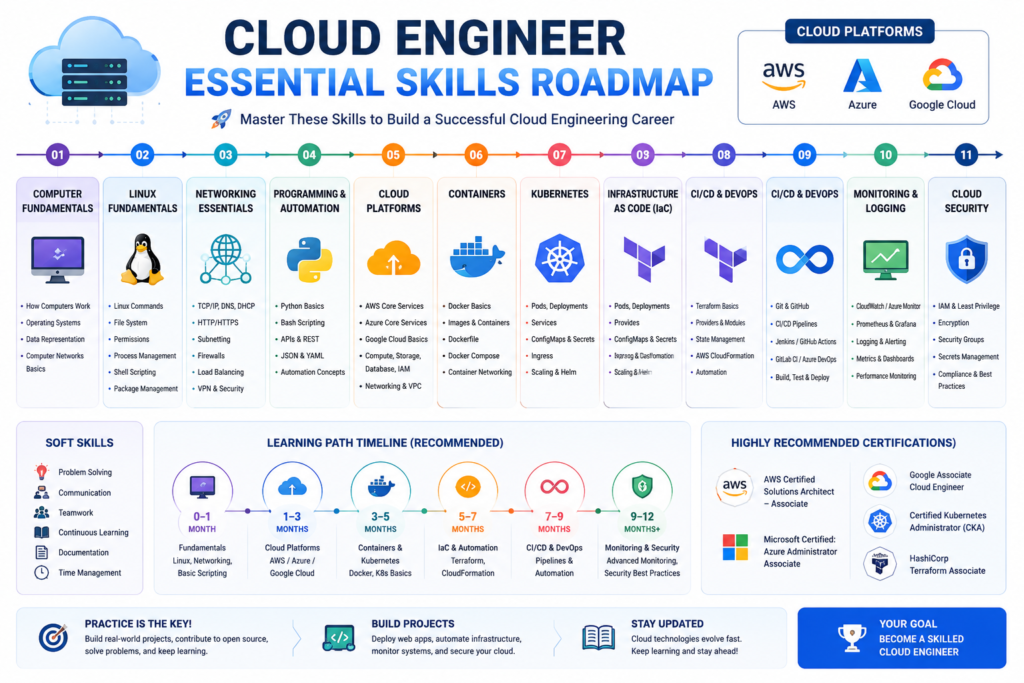
Skills Required for Cloud Engineer Roadmap
Successful Cloud Engineers combine technical knowledge with problem-solving abilities
Technical Skills
Cloud Computing
- AWS
- Azure
- Google Cloud Platform
Linux
Understand:
- File systems
- Shell scripting
- User management
- Permissions
- Package management
Networking
Learn:
- TCP/IP
- DNS
- HTTP/HTTPS
- VPN
- Firewalls
- Load Balancers
- Subnets
Programming
Recommended languages:
- Python
- Bash
- PowerShell
- Go (Optional)
Virtualization
Learn:
- VMware
- VirtualBox
- Hyper-V
Containers
Understand:
- Docker
- Kubernetes
Infrastructure as Code (IaC)
Learn:
- Terraform
- AWS CloudFormation
- Pulumi (Optional)
CI/CD
Understand:
- GitHub Actions
- Jenkins
- GitLab CI/CD
- Azure DevOps
Monitoring
Use:
- Grafana
- Prometheus
- CloudWatch
- Azure Monitor
Security
Study:
- IAM
- MFA
- Encryption
- Secrets Management
- Compliance
Databases
Learn:
- MySQL
- PostgreSQL
- MongoDB
- Redis
Soft Skills
- Communication
- Problem Solving
- Critical Thinking
- Documentation
- Teamwork
- Time Management
- Continuous Learning
Essential Tools & Software for Cloud Engineer Roadmap
Cloud Platforms
- Amazon Web Services (AWS)
- Microsoft Azure
- Google Cloud Platform
Operating Systems
- Linux
- Windows Server
Programming
- Python
- Bash
- PowerShell
Version Control
- Git
- GitHub
Containers
- Docker
- Kubernetes
Infrastructure as Code
- Terraform
- CloudFormation
CI/CD
- Jenkins
- GitHub Actions
- GitLab CI
- Azure DevOps
Monitoring
- Prometheus
- Grafana
- CloudWatch
- Datadog
Security
- HashiCorp Vault
- AWS IAM
- Azure Active Directory
Databases
- MySQL
- PostgreSQL
- MongoDB
Networking Tools
- Wireshark
- Nmap
- PuTTY
- OpenSSH
IDEs
- Visual Studio Code
- IntelliJ IDEA
- PyCharm
Step-by-Step Cloud Engineer Roadmap
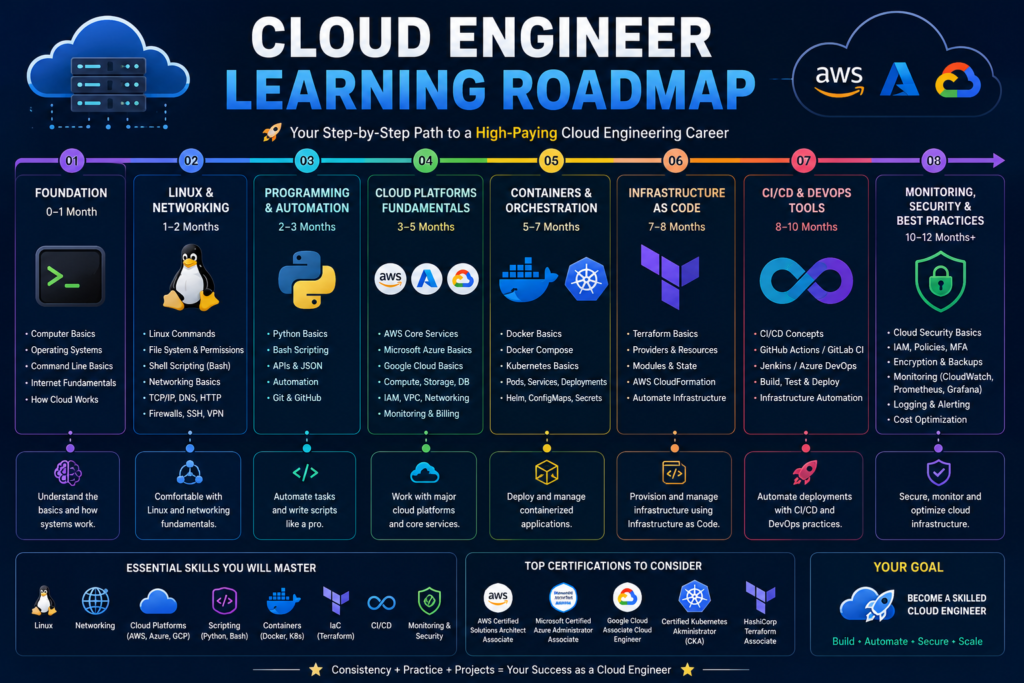
Becoming a Cloud Engineer requires a combination of networking knowledge, operating system administration, cloud platforms, automation, security, and real-world deployment experience. Follow this roadmap step by step instead of trying to learn everything at once.
Step 1 – Learn Computer Fundamentals (Weeks 1–2)
Before working with cloud platforms, understand how computers and networks operate.
Topics to Learn
- Computer hardware basics
- Operating systems
- File systems
- Command line basics
- Internet fundamentals
- Client-server architecture
Goal
Understand how applications communicate before moving to cloud infrastructure.
Step 2 – Master Linux (Month 1)
Linux powers most cloud servers.
Learn
- Linux installation
- Terminal commands
- User management
- File permissions
- SSH
- Bash scripting
- Package management
- Services
- Cron jobs
Practice Projects
- Host a static website
- Create automated backup scripts
- Configure multiple users
Step 3 – Learn Networking (Month 2)
Cloud infrastructure is built on networking concepts.
Topics
- IP Addressing
- TCP/IP
- DNS
- DHCP
- HTTP/HTTPS
- Firewalls
- Routing
- NAT
- VPN
- Load Balancing
Goal
Understand how cloud services communicate securely.
Step 4 – Learn Python & Bash (Month 2)
Automation is one of the most important cloud engineering skills.
Python Topics
- Variables
- Loops
- Functions
- APIs
- JSON
- File handling
Bash Topics
- Shell scripting
- Automation
- Cron jobs
Beginner Projects
- Server monitoring script
- Automatic backup script
- File organizer
- Cloud storage uploader
Step 5 – Learn Git & GitHub (Week 1)
Version control is essential.
Learn:
- Git repositories
- Commit
- Branch
- Merge
- Pull Requests
- GitHub Actions
Upload every project to GitHub.
Step 6 – Learn AWS (Month 3–4)
AWS is the world’s most widely used cloud platform.
Services to Learn
- EC2
- S3
- IAM
- VPC
- Route 53
- RDS
- Lambda
- CloudWatch
- Auto Scaling
- Elastic Load Balancer
- CloudFormation
Practice
Deploy a complete web application on AWS.
Step 7 – Learn Microsoft Azure (Month 5)
Azure is heavily used by enterprise organizations.
Learn
- Azure Virtual Machines
- Azure Storage
- Azure Networking
- Azure Active Directory
- Azure Functions
- Azure Monitor
Step 8 – Learn Google Cloud Platform (Month 5)
Understanding multiple cloud providers increases job opportunities.
Learn
- Compute Engine
- Cloud Storage
- Cloud Functions
- Cloud SQL
- Kubernetes Engine
Step 9 – Learn Containers (Month 6)
Containers make application deployment consistent and scalable.
Docker
Learn:
- Images
- Containers
- Dockerfile
- Docker Compose
- Volumes
- Networking
Projects
- Dockerize a Python application
- Deploy a web application in Docker
Step 10 – Learn Kubernetes (Month 7)
Kubernetes manages containerized applications.
Topics:
- Pods
- Services
- Deployments
- Namespaces
- ConfigMaps
- Secrets
- Ingress
- Scaling
Deploy your first Kubernetes cluster.
Step 11 – Learn Infrastructure as Code (Month 8)
Modern cloud engineers automate infrastructure.
Learn
- Terraform
- AWS CloudFormation
Projects
- Deploy EC2 automatically
- Create VPC using Terraform
- Build reusable infrastructure modules
Step 12 – Learn CI/CD (Month 9)
Continuous Integration and Continuous Deployment improve software delivery.
Learn:
- GitHub Actions
- Jenkins
- GitLab CI/CD
- Azure DevOps
Build automated deployment pipelines.
Step 13 – Learn Monitoring & Logging (Month 10)
Monitoring ensures cloud systems remain healthy.
Learn:
- Prometheus
- Grafana
- CloudWatch
- Azure Monitor
- ELK Stack
Projects
- Create monitoring dashboards
- Configure server alerts
- Analyze application logs
Step 14 – Learn Cloud Security (Month 10)
Security is a critical responsibility for every Cloud Engineer.
Topics
- IAM
- MFA
- Encryption
- Secrets Management
- Security Groups
- Compliance
- Backup & Disaster Recovery
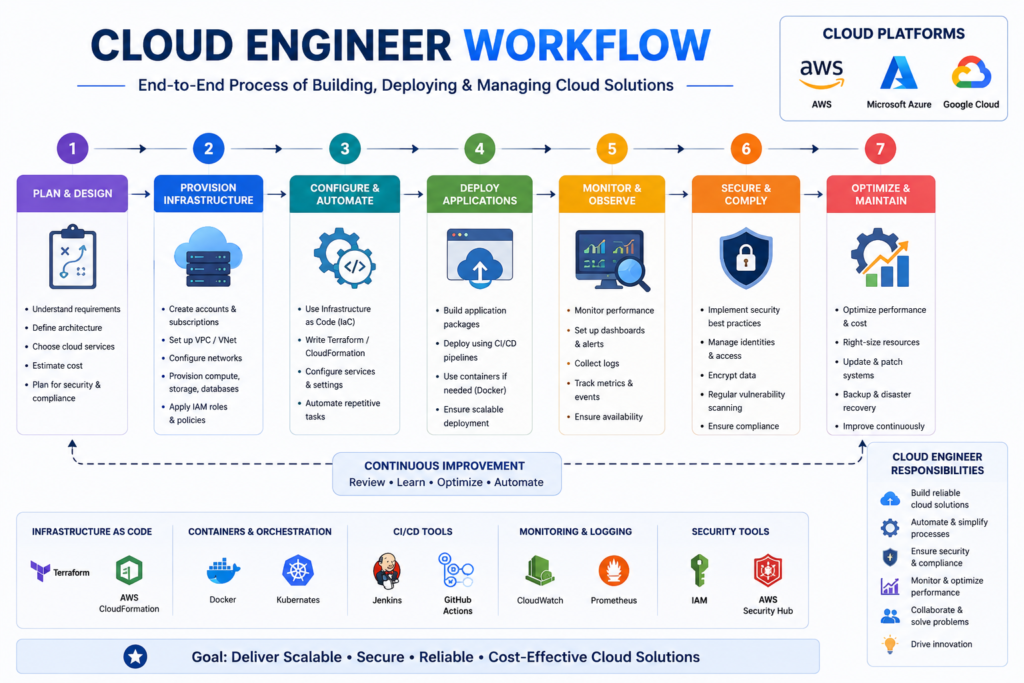
Beginner Projects for Cloud Engineer Roadmap
Projects demonstrate your practical skills better than certifications alone.
Beginner Projects
- Host a static website on AWS S3
- Linux server setup
- Personal cloud storage
- SSH remote server configuration
- Server monitoring dashboard
Intermediate Projects
- Deploy a three-tier web application
- CI/CD pipeline using GitHub Actions
- Dockerized Flask application
- Kubernetes deployment
- Auto Scaling AWS infrastructure
- Terraform infrastructure project
Advanced Projects
- Multi-cloud deployment
- Highly available web application
- Serverless application
- Cloud cost optimization dashboard
- Kubernetes production cluster
- Infrastructure as Code automation
- Secure cloud architecture
- Cloud monitoring system
- Disaster recovery solution
- AI-powered cloud monitoring dashboard
Portfolio Tips for Cloud Engineer
Your portfolio is one of the first things recruiters evaluate.
Create a Professional GitHub
Include:
- Clean repositories
- README files
- Architecture diagrams
- Deployment instructions
- Screenshots
- Documentation
Build a Portfolio Website
Include:
- About Me
- Skills
- Certifications
- Cloud Projects
- Resume
- Contact Information
- GitHub
Showcase Cloud Architecture
Instead of only showing code, include:
- AWS architecture diagrams
- Terraform files
- Kubernetes manifests
- Monitoring dashboards
- Deployment screenshots
Document Every Project
Explain:
- Problem
- Solution
- Architecture
- Technologies
- Challenges
- Lessons learned
Internship Guide for Cloud Engineer Roadmap
Internships provide valuable real-world cloud experience.
Build Skills Before Applying
Learn:
- Linux
- Networking
- AWS Basics
- Git
- Docker
Build Projects
Recruiters value practical projects more than certificates alone.
Create an ATS-Friendly Resume
Include:
- Technical Skills
- Cloud Platforms
- Projects
- Certifications
- GitHub
- Portfolio Website
Where to Find Internships
- LinkedIn Jobs
- Indeed
- Glassdoor
- Wellfound
- Company Career Pages
- University Career Centers
Interview Preparation
Common interview topics:
- Linux commands
- Networking
- AWS services
- Docker
- Kubernetes
- Terraform
- Python
- Cloud security
Best Certifications for Cloud Engineer Roadmap
Cloud certifications validate your knowledge and can improve your resume.
| Certification | Provider | Level |
|---|---|---|
| AWS Certified Cloud Practitioner | AWS | Beginner |
| AWS Certified Solutions Architect – Associate | AWS | Intermediate |
| AWS Certified SysOps Administrator | AWS | Intermediate |
| Microsoft Azure Fundamentals (AZ-900) | Microsoft | Beginner |
| Microsoft Azure Administrator (AZ-104) | Microsoft | Intermediate |
| Google Associate Cloud Engineer | Beginner | |
| Google Professional Cloud Architect | Advanced | |
| Certified Kubernetes Administrator (CKA) | CNCF | Advanced |
| HashiCorp Terraform Associate | HashiCorp | Intermediate |
| CompTIA Cloud+ | CompTIA | Beginner |
Best Courses & Books
Best Online Courses
- AWS Cloud Practitioner Essentials
- AWS Solutions Architect Associate
- Microsoft Learn Azure Training
- Google Cloud Skills Boost
- Docker Mastery
- Kubernetes for Beginners
- Terraform Associate Course
- Linux Foundation Training
Best YouTube Channels
- AWS
- Microsoft Azure
- Google Cloud Tech
- TechWorld with Nana
- FreeCodeCamp
- KodeKloud
Best Books
Beginner
- AWS Certified Cloud Practitioner Study Guide – Ben Piper & David Clinton
- The Linux Command Line – William Shotts
Intermediate
- Terraform: Up & Running – Yevgeniy Brikman
- Docker Deep Dive – Nigel Poulton
Advanced
- Kubernetes Up & Running – Brendan Burns
- Designing Data-Intensive Applications – Martin Kleppmann
Learning Timeline
| Stage | Duration | Focus |
|---|---|---|
| Beginner | 0–2 Months | Linux, Networking, Python, Git |
| Intermediate | 2–5 Months | AWS, Azure, Google Cloud |
| Advanced | 5–8 Months | Docker, Kubernetes, Terraform |
| Professional | 8–10 Months | CI/CD, Monitoring, Security |
| Job Ready | 10–15 Months | Portfolio, Certifications, Internships, Interview Preparation |
Pro Tip: Aim to spend 2–3 hours daily on hands-on practice. Build projects in a personal cloud account, document your work on GitHub, and deploy real applications. Practical experience is one of the strongest ways to stand out when applying for Cloud Engineer roles.
Cloud Engineering is one of the highest-paying careers in information technology. Salaries vary depending on your experience, certifications, location, cloud platform expertise, and the size of the organization.
Cloud Engineer Salary in the United States
| Experience Level | Average Annual Salary |
|---|---|
| Entry-Level | $95,000–$120,000 |
| Mid-Level | $120,000–$150,000 |
| Senior | $150,000–$180,000+ |
| Cloud Architect | $170,000–$220,000+ |
Cloud Engineer Salary in Pakistan
| Experience Level | Average Monthly Salary |
|---|---|
| Entry-Level | PKR 120,000–200,000 |
| Mid-Level | PKR 200,000–400,000 |
| Senior | PKR 400,000–700,000+ |
| International Remote Jobs | PKR 800,000–1,800,000+ |
Note: Salaries vary based on the employer, city, certifications, and years of experience.
Cloud Engineer Salary by Cloud Platform
| Cloud Platform | Demand | Salary Potential |
|---|---|---|
| Amazon Web Services (AWS) | Very High | ⭐⭐⭐⭐⭐ |
| Microsoft Azure | Very High | ⭐⭐⭐⭐⭐ |
| Google Cloud Platform (GCP) | High | ⭐⭐⭐⭐☆ |
| Multi-Cloud Expertise | Extremely High | ⭐⭐⭐⭐⭐ |
Factors That Increase Salary
- AWS Professional Certifications
- Azure Expert Certifications
- Kubernetes expertise
- Terraform experience
- DevOps skills
- Cloud Security knowledge
- Python automation
- Multi-cloud experience
- Real-world production projects
- Strong communication skills
Career Progression
Cloud Engineering offers multiple career growth opportunities. As you gain experience, you can move into more specialized or leadership roles.
IT Support Technician

↓

System Administrator

↓

Junior Cloud Engineer

↓

Cloud Engineer

↓

Senior Cloud Engineer

↓

Cloud DevOps Engineer

↓

Cloud Solutions Architect

↓

Cloud Security Engineer

↓

Principal Cloud Architect

↓

Cloud Engineering Manager

↓

Head of Cloud Infrastructure

↓

Chief Technology Officer (CTO)
Popular Career Paths
Cloud Engineer → DevOps Engineer
Focus on:
- CI/CD
- Kubernetes
- Automation
- Infrastructure as Code
Cloud Engineer → Cloud Architect
Focus on:
- Enterprise Architecture
- Cost Optimization
- Multi-Cloud Design
- Solution Design
Cloud Engineer → Cloud Security Engineer
Focus on:
- Identity & Access Management
- Security Compliance
- Encryption
- Zero Trust Architecture
Cloud Engineer → Site Reliability Engineer (SRE)
Focus on:
- Reliability
- Monitoring
- Performance Optimization
- Automation
Job Market Outlook
Cloud computing continues to grow as businesses migrate from traditional infrastructure to cloud-based solutions.
Why Demand Is Increasing
- Digital transformation across industries
- Growth of remote work
- AI and machine learning adoption
- Expansion of SaaS platforms
- Increased cybersecurity requirements
- Rise of cloud-native applications
- Multi-cloud strategies
Industries Hiring Cloud Engineers
- Technology
- Banking & Finance
- Healthcare
- Government
- E-commerce
- Telecommunications
- Manufacturing
- Education
- Gaming
- Artificial Intelligence
- Startups
Companies Hiring Cloud Engineers
Examples include:
- Amazon
- Microsoft
- IBM
- Oracle
- Accenture
- Deloitte
- Cisco
- Netflix
- Spotify
- Airbnb
- PayPal
Thousands of startups also hire Cloud Engineers for remote positions.
Future Outlook
Cloud Engineering is expected to remain one of the fastest-growing IT careers over the next decade.
Professionals with expertise in:
- Kubernetes
- Terraform
- DevOps
- Cloud Security
- AI Infrastructure
- Multi-Cloud Architecture
will have especially strong job prospects.
Pros & Cons
Advantages
✅ High salary potential
✅ Strong global demand
✅ Excellent remote work opportunities
✅ Continuous learning and innovation
✅ Multiple career paths
✅ High job security
✅ Opportunity to work with cutting-edge technologies
✅ Opportunities to work internationally
Disadvantages
❌ Continuous learning is required
❌ Complex cloud ecosystems
❌ High responsibility for production systems
❌ On-call duties in some organizations
❌ Cloud certification costs
❌ Fast-changing technologies
Common Mistakes Beginners Make
Avoid these mistakes to accelerate your learning and career growth.
Skipping Linux Fundamentals
Many beginners jump directly into AWS or Azure without understanding Linux.
Linux is a foundational skill for Cloud Engineers.
Ignoring Networking
Networking concepts are essential for designing secure and scalable cloud environments.
Learning Multiple Cloud Platforms at Once
Start with one platform, preferably AWS, before expanding to Azure or Google Cloud.
Avoiding Hands-On Practice
Watching tutorials alone isn’t enough.
Build real projects and deploy applications in the cloud.
Ignoring Infrastructure as Code
Modern Cloud Engineers automate infrastructure using tools like Terraform instead of manually creating resources.
Not Learning Containers
Docker and Kubernetes have become essential skills for modern cloud roles.
Forgetting Security
Always follow security best practices, including least-privilege access, encryption, and secure credential management.
Not Building a Portfolio
A strong GitHub profile and portfolio website can significantly improve your chances of landing interviews.
Frequently Asked Questions
Is Cloud Engineering a good career in 2026?
Yes. Cloud Engineering remains one of the highest-paying and most in-demand careers in IT, with strong opportunities for remote and international work.
Do I need a Computer Science degree?
No. While a degree can help, many Cloud Engineers are self-taught through online courses, certifications, and practical projects.
Which cloud platform should I learn first?
Amazon Web Services (AWS) is often recommended because of its large market share and extensive learning resources.
How long does it take to become a Cloud Engineer?
With consistent study and hands-on practice, most learners can become job-ready in 8–15 months.
Is coding required?
Basic programming skills are important, especially in Python, Bash, or PowerShell, but Cloud Engineering is not as code-intensive as software development.
Which certification should I earn first?
The AWS Certified Cloud Practitioner or Microsoft Azure Fundamentals (AZ-900) are excellent starting points for beginners.
Can I work remotely as a Cloud Engineer?
Yes. Many companies hire Cloud Engineers for fully remote or hybrid roles.
Is Cloud Engineering stressful?
It can be during production incidents or system outages, but strong automation, monitoring, and teamwork help manage these situations effectively.
Related Careers
If you’re interested in Cloud Engineering, you may also want to explore these career paths:
- DevOps Engineer
- Site Reliability Engineer (SRE)
- Cloud Solutions Architect
- Cloud Security Engineer
- Platform Engineer
- Systems Administrator
- Network Engineer
- Cybersecurity Engineer
- Software Engineer
- AI Infrastructure Engineer
- Data Engineer
- Machine Learning Engineer
Conclusion / Next Steps
Cloud Engineering is one of the most rewarding technology careers in 2026, offering excellent salaries, global job opportunities, and the chance to work with cutting-edge cloud technologies.
The key to success is building a strong foundation before moving into advanced cloud services. Start with Linux, networking, and basic programming, then learn one cloud platform—such as AWS—before expanding to Azure or Google Cloud. As you progress, develop expertise in Docker, Kubernetes, Terraform, CI/CD, and cloud security while building real-world projects that showcase your abilities.
Consistency is more important than speed. By following the roadmap in this guide, earning industry-recognized certifications, and creating a portfolio of practical cloud projects, you’ll be well-prepared for internships, entry-level roles, and long-term career growth.
Next Steps
- Learn Linux and networking fundamentals.
- Choose your first cloud platform (AWS is a great starting point).
- Build hands-on cloud projects every month.
- Publish your work on GitHub and create a professional portfolio.
- Earn your first cloud certification.
- Apply for internships and junior Cloud Engineer roles.
- Continue learning advanced cloud technologies to stay competitive.
Explore More Career Roadmaps on PathRevo
Continue your learning journey with these comprehensive guides: